
8 Rules Of Link Building
Link building is the practice of acquiring links from other websites to your own website. These links can help search engines discover and understand your content, while high-quality, relevant links can contribute to your website’s authority and visibility in search results.
However, successful link building is not just about getting as many links as possible. The quality, relevance, placement, and overall nature of the links matter. That is why it is important to follow some basic principles when building links.
If you want to learn more about SEO and link building, you can also explore our AI Powered Digital Marketing Course in Jalandhar.
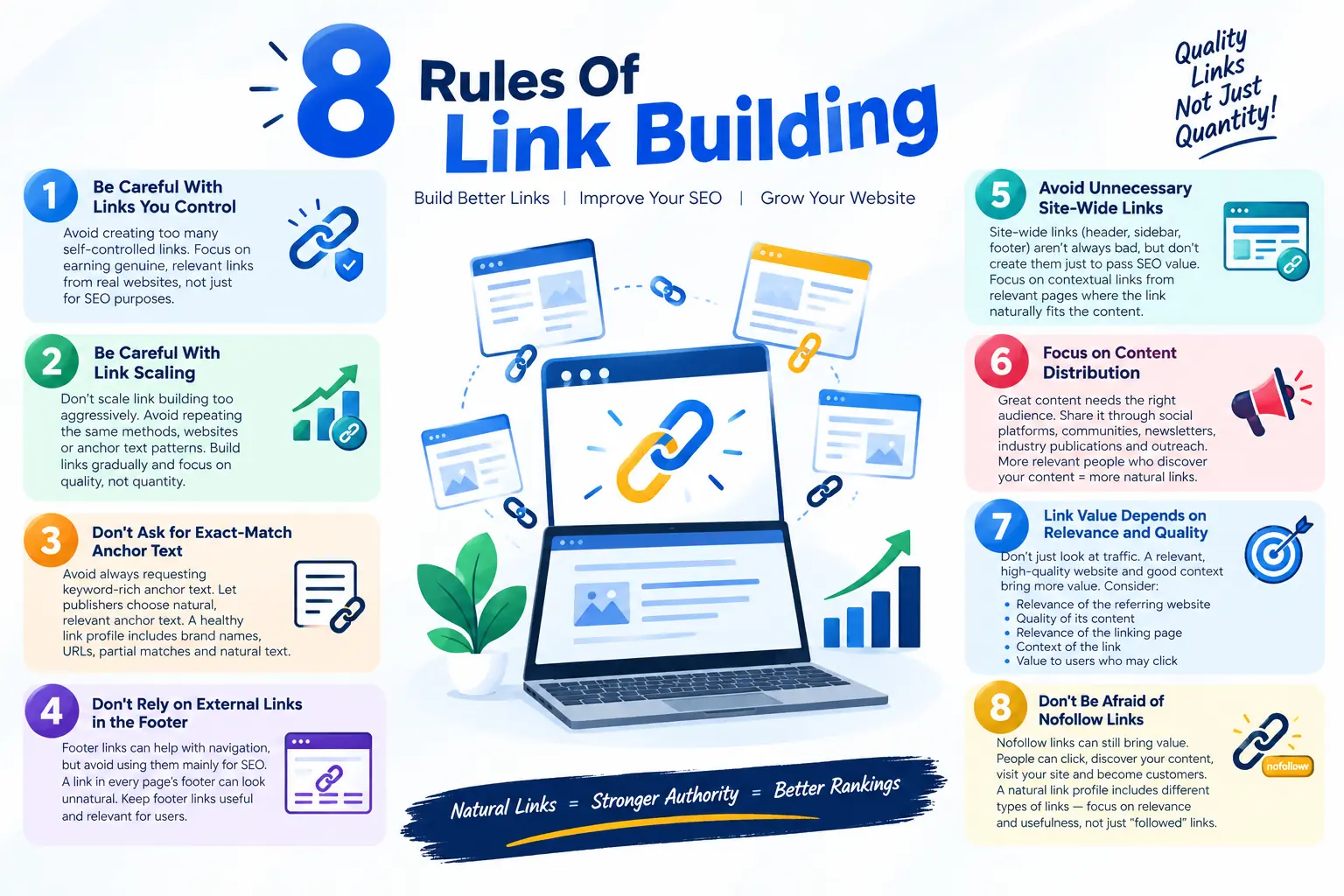
List of 8 Rules OF Link Building:-
1. Be Careful With Links You Control
One of the first things to consider when building links is how much control you have over those links.
Creating a large number of self-controlled links, especially for the purpose of manipulating search rankings, can make your link profile look unnatural. This includes excessive use of links from websites, pages, or platforms that you control solely for SEO purposes.
Instead of focusing on creating links wherever possible, concentrate on earning relevant and useful links from genuine websites. A natural link profile should contain links from different sources and should make sense in the context of the content.
2. Be Careful With Link Scaling
Scaling link building too aggressively can create problems, particularly when the same methods, websites, or anchor text patterns are repeatedly used.
For example, creating a large number of similar links in a short period of time or using the same optimized anchor text repeatedly can make your link profile appear unnatural.
Rather than focusing on quantity, build links gradually and prioritize relevance and quality. A sustainable link-building strategy should focus on earning links that provide genuine value to users.
3. Don’t Ask for Exact-Match Anchor Text
When reaching out to website owners or contributing guest posts, avoid repeatedly requesting specific, keyword-rich anchor text.
For example, if your target keyword is “digital marketing course,” asking every website to link to your page using exactly that phrase can create an overly optimized anchor-text profile.
A more natural approach is to allow publishers to choose anchor text that fits their content and context. Brand names, URLs, partial-match phrases, and natural descriptive text can all be part of a healthy link profile.
The goal should be to earn links naturally rather than trying to control every detail of how other websites link to you.
4. Don’t Rely on External Links in the Footer
Footer links can be useful when they help visitors navigate a website, but using footer links primarily for SEO or placing large numbers of external links across the entire site is not a good link-building strategy.
A link that appears in the footer of every page may be repeated hundreds or thousands of times. If those links are primarily intended to manipulate rankings, they can create an unnatural linking pattern.
Keep footer links useful and relevant to users. When adding external links, consider whether they genuinely improve the website’s navigation or provide additional value.
5. Avoid Unnecessary Site-Wide Links
Site-wide links are links that appear across many or all pages of a website, such as links in the header, sidebar, or footer.
These links are not automatically bad. For example, navigation links and legitimate partner or resource links can naturally appear across a website.
However, creating site-wide links solely to pass SEO value is a practice that should be avoided. Instead, focus on earning contextual links from relevant pages where the link naturally supports the topic being discussed.
6. Focus on Content Distribution
Creating great content is only one part of link building. You also need to make sure that the right audience can discover it.
Content distribution can help your articles, guides, research, and other resources reach people who may find them useful and potentially reference them from their own websites.
You can distribute content through relevant communities, social platforms, email newsletters, industry publications, outreach, and other legitimate channels.
The more relevant people who discover useful content, the greater the opportunity for natural mentions and links.
7. Link Value Depends on Relevance and Quality
When evaluating a link, don’t focus only on the amount of traffic that the referring website receives.
The relevance and quality of the website and the context in which the link appears are also important. A link from a relevant website that attracts the right audience may be more useful than a link from a high-traffic website with little connection to your topic.
Therefore, instead of chasing link quantity, consider factors such as:
- Relevance of the referring website
- Quality and usefulness of its content
- Relevance of the linking page
- Context in which the link is placed
- Potential value to the users who may click the link
In other words, link value is not simply about traffic volume; traffic quality and relevance matter as well.
8. Don’t Be Afraid of Nofollow Links
Not every valuable link needs to be a traditional followed link.
Nofollow links were introduced to tell search engines that the publisher does not necessarily endorse or want to pass ranking credit through the link. Google also supports additional link attributes such as rel=”ugc” and rel=”sponsored” for specific types of links.
A nofollow link can still have value because people can click it, discover your content, visit your website, and potentially become customers or readers.
Therefore, don’t reject a relevant link simply because it is nofollow. A natural link profile can contain different types of links, and the primary focus should be on whether the link is useful and relevant to your audience.
Final Thoughts
Effective link building is not about creating the maximum number of backlinks. It is about building a natural, relevant, and useful link profile over time.
Focus on creating valuable content, building genuine relationships, earning relevant mentions, and distributing your content to the right audience. Avoid excessive control over anchor text, unnecessary site-wide links, and link-building practices designed purely to manipulate search rankings.
A sustainable link-building strategy should always put quality, relevance, and users first.